Laser Hair Removal Guide
Laser Hair Removal: How It Works, How Many Sessions You Need & What to Expect
Laser hair removal can create long-term reduction in unwanted hair, but it is not one-and-done and it does not work equally well on every hair color. Here is the treatment journey from your first shave to your final maintenance visit.
Laser hair removal heats pigment in the hair and follicle to reduce future growth. Most people need a series because only some hairs are in the best growth stage at each visit. At Skin Works, a typical starting plan is six sessions, followed by reassessment for any added or maintenance treatments.
Best target: dark, coarse hair.
Weak target: blonde, red, white or gray hair, because there may be too little pigment for reliable laser targeting.
If you are new to laser hair removal, the process is easier to understand when you think of it as a series of controlled treatments rather than a single appointment. Each visit targets a new group of hairs as they enter a responsive stage of the growth cycle.
How Does Laser Hair Removal Work?
Laser hair removal uses light energy that is absorbed by melanin, the pigment in hair. That light becomes heat inside the hair structure and follicle. The goal is to damage the structures that support future hair growth while limiting heat in the surrounding skin.
This is why dark, coarse hair is usually the easiest target. It contains more pigment for the laser to “see.” Blonde, red, white and gray hair may contain too little melanin for reliable treatment.
Laser hair removal is also different from IPL. A true laser uses a specific wavelength, while IPL uses a broad range of light. Our separate guide explains IPL vs. laser hair removal in more detail.
How Many Laser Hair Removal Sessions Do You Need?
There is no perfect number for everyone. Mayo Clinic notes that many people need about 4 to 8 treatments. Skin Works currently uses a six-session package as the standard starting plan, with extra or maintenance sessions based on the response.
The reason is the hair-growth cycle. Not every follicle is in the same stage at the same time. Laser works best when a dark hair is actively connected to the follicle, so repeated sessions allow the provider to treat new groups of responsive hairs.
The interval between appointments also varies by area. Facial hair may cycle differently from legs, back or bikini hair. A fixed interval for every body area is not ideal.
Your Laser Hair Removal Journey
1. Consultation
Your provider reviews skin tone, hair color and thickness, treatment area, sun exposure, medications, medical history and prior hair-removal methods. This is also when the laser type and treatment plan are selected.
2. Stop pulling hair from the root
Avoid waxing, tweezing and threading before treatment. The laser needs pigmented hair in the follicle to create a useful target.
3. Shave before the appointment
Shaving removes hair above the skin but leaves the follicle target in place. Follow your clinic’s timing instructions, which commonly means shaving the day before treatment.
4. Laser treatment
Protective eyewear is used. The provider passes the laser over the treatment area using settings chosen for the skin and hair. Many patients describe the pulses as warm pinpricks or a quick rubber-band snap.
5. Early recovery
Temporary redness, warmth and swelling around follicles are common. Most people return to normal daily activities quickly, although the skin may feel sensitive for a short time.
6. Shedding
Treated hairs do not vanish the moment the laser fires. They often shed gradually over the following days and weeks.
7. Repeat and reassess
As more hairs enter a responsive growth stage, later sessions target them. After the initial series, the provider checks what remains and whether maintenance is worthwhile.
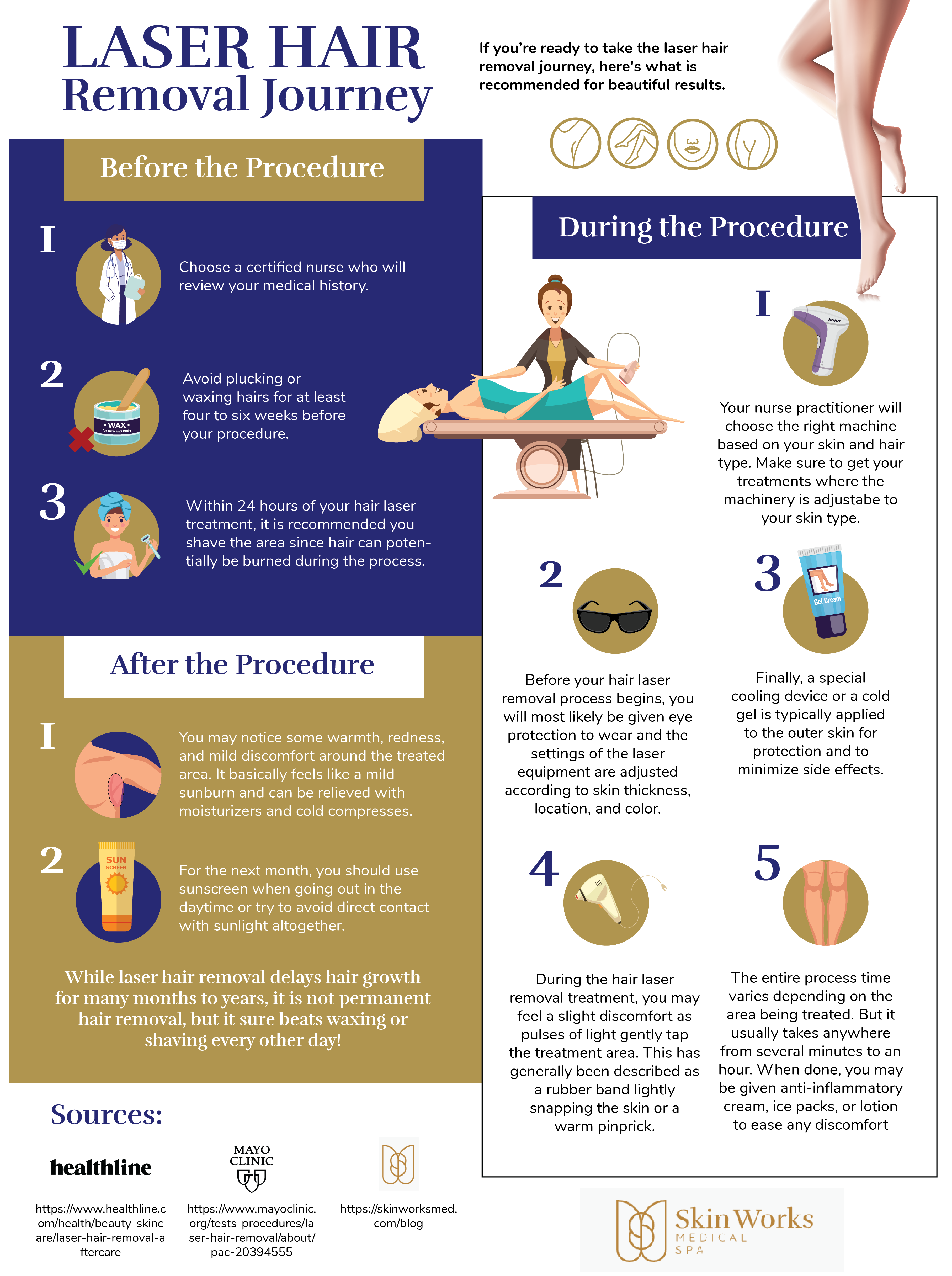
Infographic: The Laser Hair Removal Journey
Prefer the visual version? This is the original Skin Works guide that accompanied this article.
How Should You Prepare?
Good preparation helps the provider treat the hair target without adding unnecessary skin risk.
Avoid tanning and recent heavy sun exposure. Stop waxing, plucking or electrolysis for the period your provider recommends. Shave as directed before your appointment. Tell the clinic about medications, skin conditions, recent procedures and any history of unusual reactions to light or lasers.
What Does Laser Hair Removal Feel Like?
Comfort depends on the area, hair density, settings and individual sensitivity. Many people describe a quick hot snap or pinprick with each pulse.
Modern systems often use contact cooling, chilled tips or other cooling methods to protect the skin surface and improve comfort. Treatment time can range from a few minutes for a small facial area to much longer for legs, back or several areas in one visit.
What Should You Expect After Treatment?
Short-lived redness and swelling around the follicles are common. The skin can also feel warm or mildly sunburned.
Follow the clinic’s aftercare instructions. In general, avoid unnecessary heat and irritation right after treatment and protect treated skin from the sun. The American Academy of Dermatology specifically recommends avoiding direct sun and tanning beds after laser hair removal.
Do not mistake shedding for new growth. Treated hairs can work their way out of the follicle before they fall away.
Is Laser Hair Removal Permanent?
The better phrase is permanent hair reduction, not guaranteed permanent removal of every hair.
FDA-cleared hair-removal devices commonly define permanent reduction as a long-term, stable decrease in the number of hairs that regrow after a completed treatment series. Hormonal changes and new follicle activity can still create future growth.
Some people need little maintenance. Others need periodic touch-ups. Our separate article explains how long laser hair removal results can last and why regrowth differs by area.
Can Laser Hair Removal Be Done on Darker Skin?
Yes, when the device, wavelength and settings are appropriate. Darker skin contains more epidermal melanin, so the provider needs to reduce unwanted heating of the skin while still treating the hair.
Long-pulsed 1064 nm Nd:YAG is an established option for darker skin types because the longer wavelength interacts less strongly with epidermal melanin than shorter wavelengths. Diode systems can also be used across a range of skin tones when the device and parameters are appropriate.
Skin Works uses provider-selected diode or Nd:YAG technology. Read our guide to laser hair removal for darker skin for a deeper explanation.
What Are the Risks?
The most common effects are temporary redness, swelling and discomfort. Less common complications can include blisters, burns, crusting, pigment changes and scarring.
A rare but real side effect is paradoxical hypertrichosis, where hair growth increases instead of decreases. A systematic review and meta-analysis found that this occurred mainly on the face and neck and was very uncommon outside those areas.
Eye protection is essential during treatment. The Mayo Clinic advises against laser hair removal around the eyelids, eyebrows and nearby areas because of the risk of serious eye injury.
Is Laser Hair Removal Worth It?
It can be a very good fit if you have dark, treatment-responsive hair and are tired of repeated shaving, waxing or ingrown hairs. The biggest advantage is convenience over time: less regrowth usually means less routine hair removal.
It may be a poor fit if your hair is blonde, red, white or gray, if you expect one session to remove everything, or if you cannot complete a treatment series.
A correctly chosen laser, consistent scheduling, appropriate settings and realistic maintenance expectations matter more than chasing the lowest single-session price.
What Should You Look for in a Los Angeles Laser Hair Removal Clinic?
Ask what device is being used, who evaluates your skin type, how the clinic adjusts treatment for darker skin, what happens if you tan between visits, and how the clinic handles unexpected reactions.
Skin Works offers laser hair removal in Torrance using provider-selected diode or Nd:YAG technology. The service page has the current treatment areas, packages, pricing and booking information. This article is meant to explain the process so you know what those options actually mean.
Frequently Asked Questions
How many sessions of laser hair removal do most people need?
Many people need several sessions. Mayo Clinic gives a common range of about 4 to 8 treatments. Skin Works currently uses a six-session package as the typical starting plan, then reassesses remaining growth.
Why do I need to shave before laser hair removal?
Shaving removes surface hair while keeping the follicle target in place. Waxing or tweezing removes the hair from the root, which can make treatment less useful until a new hair grows.
Does laser hair removal hurt?
Sensation varies, but many patients describe brief warm pinpricks or a rubber-band snap. Cooling helps protect the skin and improve comfort.
When does treated hair fall out?
Hair does not disappear instantly. Treated hairs often shed gradually during the days and weeks after a session.
Can laser hair removal work on blonde or gray hair?
Results are usually poor or unreliable because those hairs contain little melanin for the laser to target. Red and white hair can have the same problem.
Can dark skin be treated safely?
Yes, with an appropriate device and settings. Long-pulsed Nd:YAG is a well-established option for darker skin types, and some diode systems can also be appropriate.
Is laser hair removal really permanent?
The more accurate term is permanent hair reduction. Many treated hairs can remain absent long-term, but new or residual growth can appear and maintenance may be needed.
Can I get laser hair removal while pregnant?
Skin Works defers elective laser hair removal during pregnancy because pregnancy-specific safety data for cosmetic hair-removal treatment are limited.
Sources & Medical References
- American Academy of Dermatology: Laser Hair Removal FAQs
- Mayo Clinic: Laser Hair Removal
- U.S. FDA: Medical Lasers
- Review: Laser Hair Removal, Devices and Complications
- Review: Laser and Light Hair Reduction in Fitzpatrick Skin Types IV–VI
- Systematic Review and Meta-analysis: Paradoxical Hypertrichosis After Laser or Light Hair Removal
This article is educational and does not replace an in-person assessment. Laser choice, settings, session timing and candidacy should be based on skin tone, hair characteristics, medical history, medications, recent sun exposure and treatment area.