2026 Dermal Filler Longevity Guide + Infographic
How Long Do Dermal Fillers Last? Complete Guide + Infographic
Filler does not last one fixed amount of time. The product, treatment area, tissue movement and your own biology all matter. This guide compares the main filler categories and common products used in Los Angeles.
Most temporary dermal fillers last from about 6 months to 2 years, depending on the material, product and treatment area. Lips often fade faster than cheeks or structural areas. Some collagen-stimulating products can last up to 2 years, while permanent PMMA filler behaves differently.
Duration is gradual, not an expiration date.
A filler that “lasts 12 months” does not look identical for 12 months and suddenly disappear. Results usually soften slowly over time.
“How long will my filler last?” sounds like a simple question, but the answer changes with the product and where it is placed. Even two people treated with the same filler can notice different timelines.
Why Filler Longevity Varies
The FDA notes that filler duration depends on both the material and the area where it is injected. Product design also matters. A soft lip filler and a firmer cheek filler are made for different jobs.
Movement matters too. The lips move constantly when you speak, eat and smile, so visible correction often fades faster there. A product placed deeper in the cheek or another structural area may last longer.
Your metabolism, the amount used, injection depth, tissue quality and the result you are trying to maintain can also change when you feel ready for maintenance.
How Long Do Different Dermal Fillers Last?
The most useful way to compare filler duration is to use the product’s clinical data and approved treatment area rather than one blanket number for an entire brand.
| Filler / category | Typical or studied duration | Important context |
|---|---|---|
| Hyaluronic acid fillers | Often about 6–12 months as a broad FDA material estimate | Individual products can last longer depending on formulation and treatment area. |
| JUVÉDERM VOLUMA XC | Up to 2 years in the cheeks with optimal treatment | Duration differs by indication. VOLUMA used in the chin or temples has different clinical timelines. |
| JUVÉDERM VOLLURE XC | Up to 18 months in smile lines with optimal treatment | Designed for moderate-to-severe facial wrinkles and folds. |
| JUVÉDERM Ultra XC / VOLBELLA XC | Up to 1 year in the lips with optimal treatment | Lip movement can make maintenance timing feel shorter for some patients. |
| Restylane Kysse | Up to 1 year in the lips | Actual duration varies by metabolism, amount used and treatment goal. |
| Restylane Contour | Up to 18 months in the cheeks | Duration data are tied to the specific approved treatment area. |
| Restylane Eyelight | Up to 18 months with optimal treatment | Used for under-eye hollowing in appropriately selected patients. |
| Restylane Defyne / Refyne | Up to 1 year in approved facial wrinkles and folds | Defyne also has an approved chin indication. |
| Restylane Lyft | Up to 1 year in cheeks; shorter in some other approved areas | Clinical duration depends on whether it is used in cheeks, folds or hands. |
| Calcium hydroxylapatite | About 18 months as a broad FDA material estimate | Radiesse is the best-known product in this category. It also stimulates collagen. |
| Sculptra / PLLA | Up to 2 years | Results build gradually because PLLA stimulates collagen rather than acting like a traditional HA gel. |
| PMMA filler | Non-absorbable / permanent material | PMMA behaves differently from temporary fillers and requires especially careful product selection and placement. |
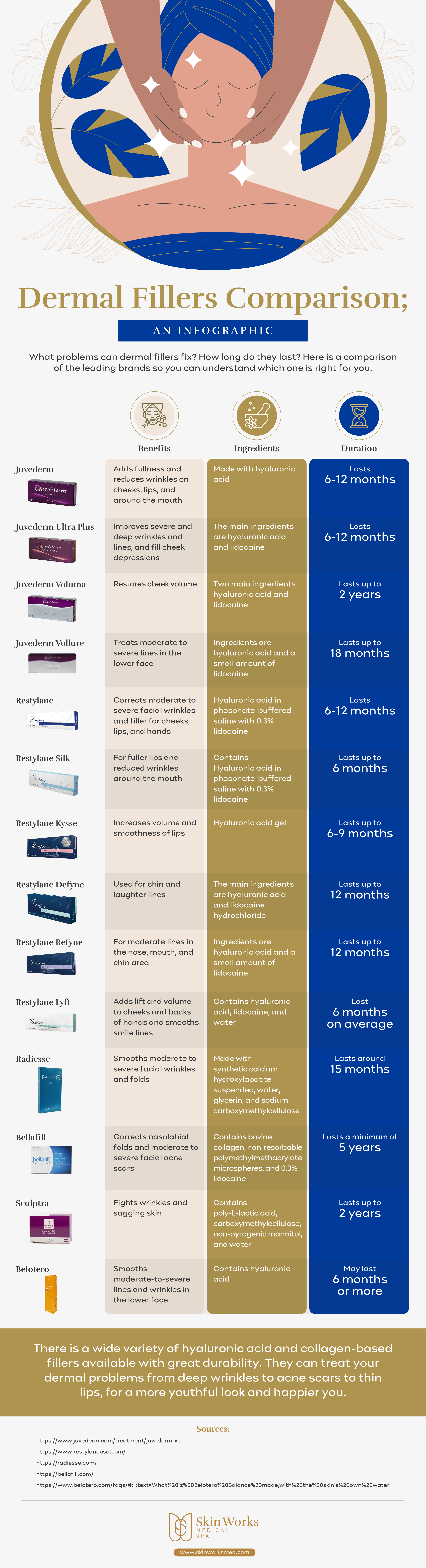
Infographic: Dermal Filler Comparison
This is the original Skin Works visual comparison that has accompanied this article since its earlier version.
Why Do Lip Fillers Often Fade Faster?
The lips are one of the most active parts of the face. They move when you speak, smile, eat and drink. That constant motion is one reason lip filler often has a shorter visible life than filler placed in a deeper, less mobile area.
That does not mean every lip filler disappears at six months. For example, both JUVÉDERM Ultra XC and VOLBELLA XC have clinical data supporting results up to one year with optimal treatment, and Restylane Kysse has data up to one year.
If your main question is about lips rather than facial filler in general, see our lip filler treatment guide.
How Long Does JUVÉDERM Last?
There is no single “JUVÉDERM duration.” The collection includes different products for different areas.
Current official JUVÉDERM information lists results up to 2 years for VOLUMA XC in the cheeks, up to 18 months for VOLLURE XC in smile lines, and up to 1 year for Ultra XC and VOLBELLA XC in the lips, all with optimal treatment.
For a product-by-product breakdown, read How Long Does JUVÉDERM Last?
How Long Does Restylane Last?
The Restylane family also varies by product and treatment area. Official manufacturer data list Kysse up to one year in the lips, Contour up to 18 months in the cheeks, Eyelight up to 18 months with optimal treatment, and Defyne or Refyne up to one year in their approved facial indications.
That is why comparing “Restylane vs. JUVÉDERM” as if each were one product is misleading. Our JUVÉDERM vs. Restylane guide explains the differences in more detail.
Is Sculptra a Dermal Filler?
Sculptra is often grouped with fillers, but it works differently. It contains poly-L-lactic acid and stimulates your own collagen production. Results develop gradually instead of appearing as a traditional gel-like volume correction.
Current Sculptra clinical information reports results lasting up to 2 years. Treatment is typically planned as a series rather than one isolated injection visit.
When Should You Get More Filler?
You do not need to wait until every trace of filler is gone. Many patients prefer maintenance when the result begins to soften but before they return fully to baseline.
On the other hand, routine top-ups should not become automatic. Your face changes with age, weight and previous treatment. A provider should reassess the area before adding more product, especially if you have had repeated filler over several years.
If the issue is skin laxity, pigment, scarring or a structural problem that filler cannot correct well, adding another syringe may create heaviness without solving the actual concern.
Can Dermal Filler Be Dissolved?
Many hyaluronic acid fillers can be reduced or dissolved with hyaluronidase when medically appropriate. That reversibility is one reason HA products are widely used.
Radiesse, Sculptra and PMMA fillers are not hyaluronic acid and cannot be dissolved in the same way. This is another reason product choice matters before treatment.
What Are the Important Filler Risks?
Common short-term effects include swelling, bruising, tenderness, redness and temporary lumps or firmness.
The most serious risk is accidental injection into a blood vessel. The FDA warns that this can cause tissue death, vision problems including blindness, or stroke. These events are uncommon, but they are why filler should be treated as a medical procedure rather than a beauty-service add-on.
Choose a licensed medical provider who understands facial anatomy, uses authentic FDA-approved products for appropriate indications, and has a plan for complications.
Dermal Fillers at Skin Works
Skin Works offers multiple filler families so the product can be matched to the area rather than using the same gel everywhere. Current options include products from the JUVÉDERM and Restylane families, Radiesse, Sculptra, Belotero and Revanesse.
See the current dermal filler treatment page for treatment areas, product categories, pricing and consultation details. If your main question is cost, our separate guide to dermal filler prices keeps that commercial topic separate from this longevity guide.
Frequently Asked Questions
How long do dermal fillers usually last?
Most temporary fillers last several months to about two years. The exact timeline depends on the filler material, specific product, treatment area and individual patient.
Which filler lasts the longest?
There is no useful single winner because products are approved for different areas and goals. Some HA products have clinical data up to 18 to 24 months, Sculptra can last up to two years, and PMMA is a non-absorbable material.
How long does lip filler last?
Many lip fillers last roughly 6 to 12 months, although product-specific clinical data may extend to one year with optimal treatment. Lip movement can make visible correction fade sooner for some patients.
How long does cheek filler last?
Cheek filler can last longer than filler in highly mobile areas. JUVÉDERM VOLUMA XC has clinical data up to two years in the cheeks with optimal treatment, while Restylane Contour has data up to 18 months.
Does filler disappear all at once?
No. Temporary filler is gradually absorbed or metabolized. The visible result usually softens over time rather than disappearing on one exact date.
Can exercise or a fast metabolism make filler disappear faster?
Individual biology can affect duration, but it is difficult to predict exactly how much any one lifestyle factor changes longevity. Product choice, treatment area and amount used are usually more useful planning factors.
Can all fillers be dissolved?
No. Hyaluronic acid fillers can often be treated with hyaluronidase when appropriate. Radiesse, Sculptra and PMMA fillers do not dissolve with hyaluronidase.
Sources & Medical References
- U.S. FDA: FDA-Approved Dermal Fillers
- U.S. FDA: Dermal Fillers, Uses and Risks
- JUVÉDERM Official Treatment Guide and Duration Information
- Restylane Official FAQs and Product Duration Data
- Sculptra Official FAQs and Duration Data
- American Society of Plastic Surgeons: How Long Do Dermal Fillers Last?
This article is educational and does not replace an in-person medical assessment. Duration claims are tied to specific products, indications and clinical studies. Individual results vary.